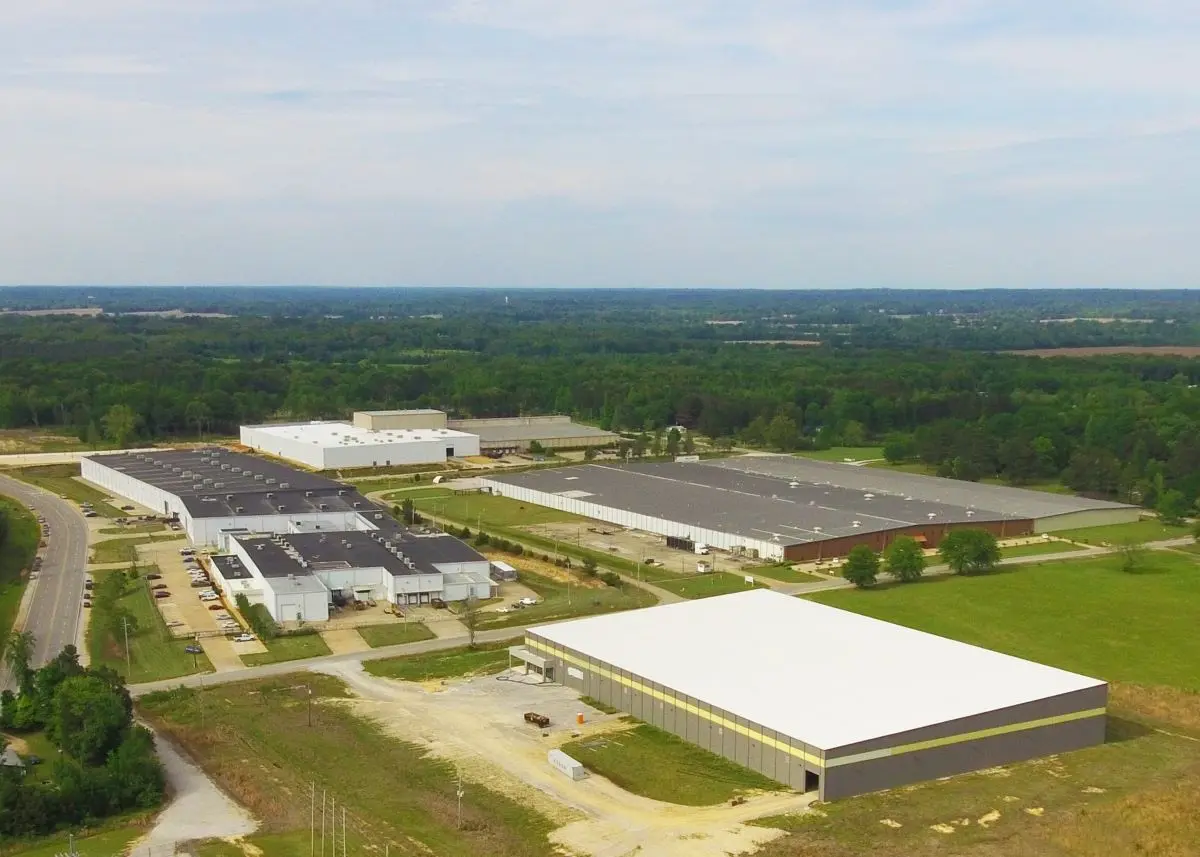
A $25 million expansion by General Atomics in Shannon signals a deeper shift in how the Magnolia State is positioning itself at the forefront of national security manufacturing.
General Atomics Doubles Down in Shannon
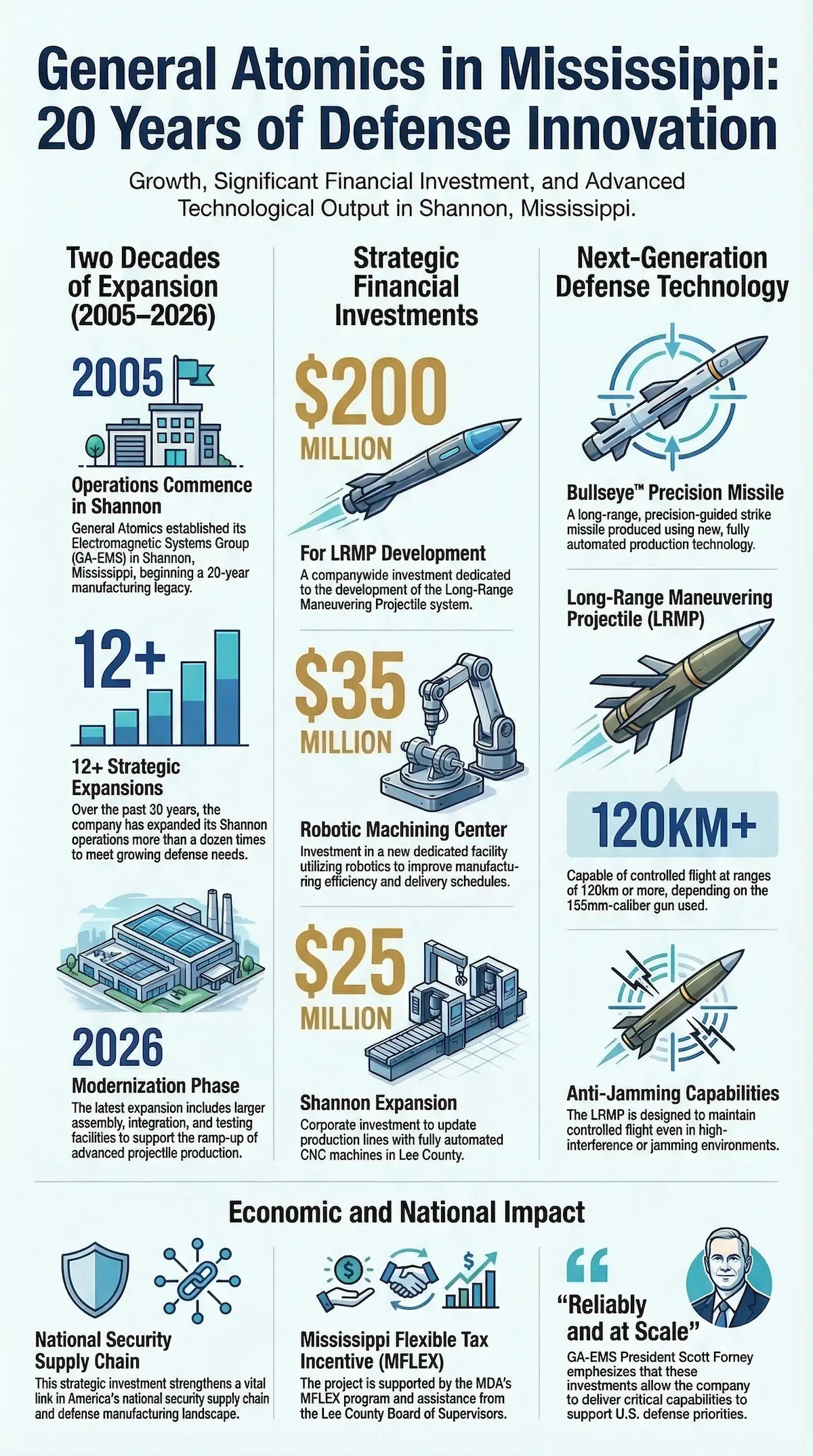
In a move that underscores Mississippi's growing prominence in defense manufacturing, General Atomics Electromagnetic Systems (GA-EMS) has announced a corporate investment exceeding $25 million at its facility in Shannon, Lee County. The project centers on a sweeping modernization of the company's production line, replacing existing equipment with fully automated computer numerical control (CNC) machinery and advanced robotics.
The primary objective of this expansion is to scale up production of cutting-edge weapon systems. At the center of that effort is the Bullseye™, a long-range precision-guided strike missile designed to deliver accuracy in contested environments. Alongside it, the facility will take on expanded assembly, integration, and testing responsibilities for the Long-Range Maneuvering Projectile (LRMP) — a sophisticated munition capable of maneuvering through signal-jamming environments at ranges exceeding 120 kilometers.
The investment is part of a broader $200 million company-wide commitment to LRMP development, which also includes a dedicated $35 million robotic machining center. Together, these upgrades position GA-EMS to compete aggressively for future U.S. Department of Defense contracts — and to deliver on existing ones faster and more efficiently than ever before.
Two Decades of Commitment: The GA-EMS Story in Mississippi
General Atomics did not arrive in Shannon overnight. The company’s Electromagnetic Systems Group first established operations in Lee County back in 2005 and has since made the region a cornerstone of its domestic manufacturing strategy. According to Governor Tate Reeves, GA-EMS has expanded its operations in Shannon more than a dozen times over the past two decades — a rate of reinvestment that is virtually unmatched among defense contractors in the region.
That track record speaks louder than any press release. When a company of this caliber continues choosing the same city, the same county, and the same workforce year after year, it signals genuine confidence — not just in the business climate, but in the people who show up to build these systems every day. For Shannon, a small city in northeast Mississippi, the relationship with GA-EMS has become a defining economic partnership.
The Ripple Effect: What This Means for Mississippi’s Economy
The announcement from GA-EMS is not happening in isolation. It is the latest and most visible example of a broader economic transformation quietly reshaping Mississippi’s identity — from a state once defined by agriculture and textiles to one increasingly recognized as a hub for high-tech defense manufacturing.
The most immediate impact is financial. A $25 million direct corporate investment triggers spending far beyond the factory floor. Construction firms, equipment suppliers, logistics companies, and technical service providers all stand to benefit as the expansion moves from blueprint to reality. But the more lasting impact lies in what the project represents: Mississippi becoming a critical link in America’s national security supply chain.
Barry Parker, President of the Lee County Board of Supervisors, has emphasized that this kind of growth supports “high-quality jobs” — and that distinction matters. Defense manufacturing positions tied to robotics and precision engineering tend to offer higher wages and stronger career pathways than many traditional manufacturing roles. As the facility integrates more automated systems, the local workforce will need to meet a higher technical bar, creating demand for training programs and community college partnerships that lift the entire regional talent pool.
Then there is the cluster effect. GA-EMS is not the only defense-related company betting on Mississippi in 2026. Spartan Composites is investing $49 million in a new facility in Saltillo — just miles from Shannon — to manufacture advanced composite materials used across defense, infrastructure, and energy sectors, creating an estimated 45 jobs. Firehawk Aerospace is setting up new manufacturing operations in Crawford. Karman Space and Defense has acquired two Gulfport-based firms to anchor a new leader in critical sub-systems for space and defense programs. And Camgian, a Mississippi-based tech company, has recently secured a position on the prestigious Golden Dome Team.
When companies in the same sector begin clustering in a region, they create self-reinforcing momentum. Suppliers follow. Talent concentrates. Universities and technical colleges align their programs. Local governments compete to offer infrastructure improvements. The result, over time, is an industrial ecosystem that is far more resilient — and far more attractive to outside investors — than any single plant expansion could achieve on its own.
State government has played a deliberate role in catalyzing this growth. The Mississippi Flexible Tax Incentive program, known as MFLEX, provided critical financial support for the GA-EMS expansion. By reducing the upfront tax burden on large-scale industrial investments, MFLEX makes the state more competitive against peer states vying for the same contracts and companies. It is a calculated bet by the Mississippi Development Authority: forgo some near-term tax revenue in exchange for long-term economic anchors that create stable, well-paying employment.
U.S. Senator Roger Wicker has publicly pointed to this wave of defense investment as evidence of Mississippi’s emerging role in what he describes as a revitalization of the American defense industry. That framing matters. When a senior member of the Senate Armed Services Committee highlights your state as a model, it carries weight in Washington budget discussions — and can open doors to future federal contracts and military infrastructure investments.
A State Redefining Its Future
The General Atomics expansion in Shannon is more than a factory upgrade. It is a signal — to investors, to policymakers, and to Mississippians themselves — that the state has what it takes to compete at the highest levels of American industrial and technological capability. For a region that has long been overlooked in national conversations about innovation and growth, that signal carries real weight.
As the missiles built in Shannon travel further and the contracts grow larger, so too does Mississippi’s claim to a seat at the table where the future of national defense is decided.
© 2026 Mississippi Lead. All rights reserved.
← Back to Mississippi Lead